Quantum100 ⊗ AI Workshop

Europe/Berlin
SoN

SoN

Koji Hashimoto (Kyoto University), Tomas Jezo (WWU ITP), Kai Schmitz
Beschreibung

Quantum100 ⊗ AI Workshop

The centennial year of the discovery of quantum mechanics is the best occasion to foresee the future of physics. Eventually this opportunity overlaps with the revolutionary development of AI, and without AI we cannot talk about the future. Here we hold a research workshop “Quantum100 ⊗ AI” in which physicists using AI or trying to unify AI with physics gather, to discuss the future of physics. The workshop consists of plenary invited talks in various physics fields centered in high energy theory, together with a poster session, and a panel discussion for the discussion of the future. 


Connected Events

The workshop is followed by the Quantum 100 ceremony, to form a unique atmosphere to discuss the future of physics.

All the registered participants of this "Quantum100 x AI" workshop are cordially invited, with free of charge, to the following conjunct precious events.


  1. Quantum Festival "Quantum100" (with symphonic orchestra). Final event of the quantum year https://quantum100.de/en/
    15.Nov.2025 (exhibition/public lectures start at 13:00, Musical concert: 19:30).
    Location: Halle Münsterland https://quantum100.de/en/arrival/
    - Enjoy the beautiful orchestration of symphony and choir, whose motif is quantum physics, to celebrate the century of quantum physics!
    International Closing Concert: https://quantum100.de/en/concert/
    - Chips: In the exhibition, one lecture on science diplomacy (16:00-) will be in English, by Götz Neuneck https://quantum100.de/en/
  2. Reception with the Major of the City together with DPG president Klaus Richter and JPS president Seiji Miyashita.
    14.Nov.2025 16:00-
    Location: Rathaus (City Hall), Prinzipalmarkt 10, 48143 Münster, https://en.wikipedia.org/wiki/Historical_City_Hall_of_M%C3%BCnster
    - Find out our future of physics, through the joint activity of German physical society and Japan physical society!
  3. International panel discussion “Role and responsibility of scientists in times of disruptive global challenges”.
    14.Nov.2025 17:30-
    Location: Erbdrostenhof, Salzstraße 38, 48143 Münster (https://www.erbdrostenhof.lwl.org/de/)
    - We strongly encourage everyone to participate in this physicist discussion, for our future of physics.

List of plenary speakers

  • Keisuke Fujii (University of Osaka)
  • Yang-Hui He (LIMS)
  • Yuji Hirono (Tsukuba University)
  • Gregor Kasieczka (University of Hamburg)
  • Keun-Yong Kim (GIST)
  • Sven Krippendorf (Cambridge University)
  • Yuki Nagai (University of Tokyo)
  • Alexander Neuwirth (University of Milano-Bicocca)
  • Mihoko Nojiri (KEK)
  • Tilman Plehn (University of Heidelberg)
  • Germán Rodrigo (CSIC-Valencia University)
  • Fabian Ruehle (Northeastern University)
  • Rak-Kyeong Seong (UNIST)
  • Malte Schilling (University of Münster)
  • Steffen Schumann (University of Göttingen)
  • Gary Shiu (University of Wisconsin)
  • Michael Spannowsky (Durham University)
  • Akio Tomiya (Tokyo Woman's Christian University)
 
Oral presentations are invited only but we welcome poster presentations. If you would like to present a poster, please submit an abstract.

Acknowledgements

The workshop receives financial support from the Heraeus foundation. 

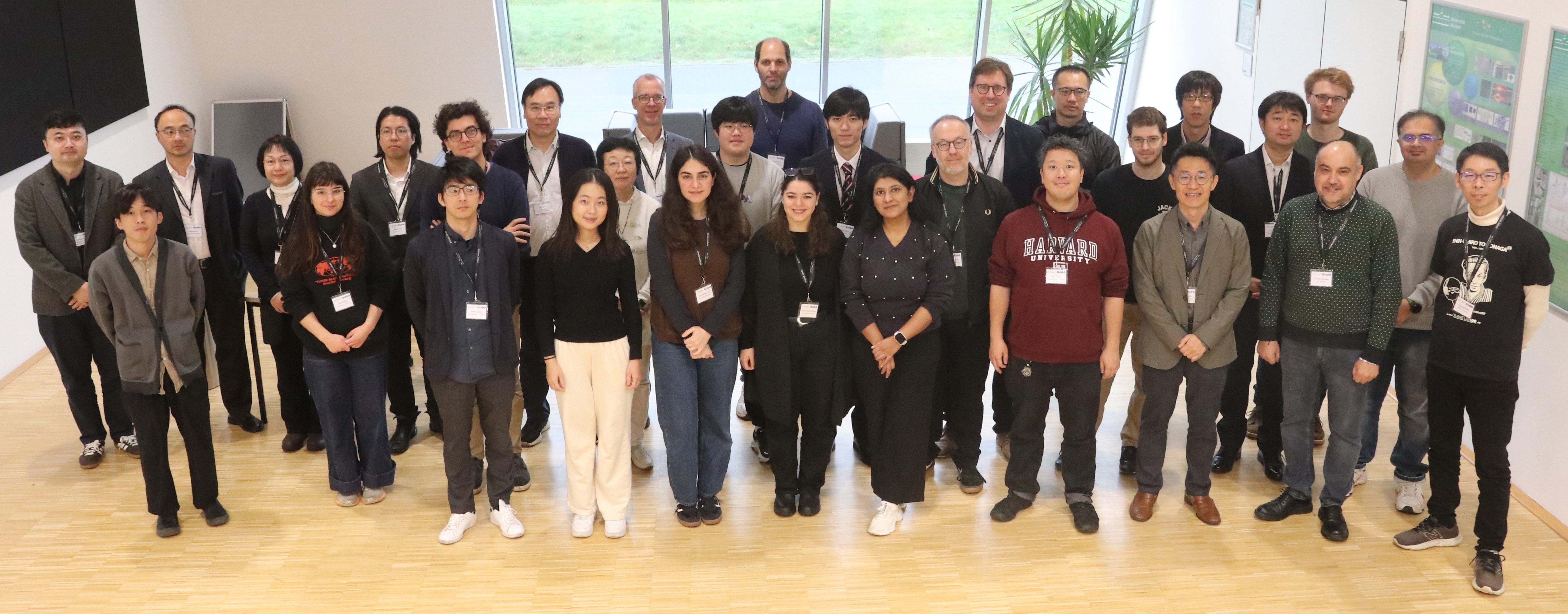
Group photo

    • 13:45 14:15
      Welcome with Coffee and Cake
    • 14:15 14:30
      Remarks: Welcome
    • 14:30 16:00
      Plenary: Day 1 Session 1
      Sitzungsleiter: Kai Schmitz
      • 14:30
        Understanding diffusion models by Feynman's path integral 30m

        Diffusion models have emerged as powerful tools in generative modeling, especially in image generation tasks. In this talk, we introduce a novel perspective by formulating diffusion models using the path integral method introduced by Feynman for describing quantum mechanics. We find this formulation providing comprehensive descriptions of score-based diffusion generative models, such as the derivation of backward stochastic differential equations and loss functions for optimization.The formulation accommodates an interpolating parameter connecting stochastic and deterministic sampling schemes, and this parameter can be identified as a counterpart of Planck's constant in quantum physics. This analogy enables us to apply the Wentzel-Kramers-Brillouin (WKB) expansion, a well-established technique in quantum physics, for evaluating the negative log-likelihood to assess the performance disparity between stochastic and deterministic sampling schemes.

        Sprecher: Yuji Hirono (University of Tsukuba)
      • 15:00
        Train by tunneling: Quantum annealing for AI optimization 30m

        Quantum annealing offers a hardware route to solving rugged discrete optimisation problems that appear throughout AI. This talk shows how to cast learning and inference tasks into QUBO or Ising form, then use forward and reverse annealing to navigate nonconvex loss landscapes. I will present compact case studies in classifier training, feature selection, model selection, and physics parameter fitting, benchmarking against classical heuristics and highlighting when tunnelling provides a real advantage. Practical guidance covers minor embedding, precision limits, and zooming strategies, as well as hybrid loops where annealers act as inner optimisers within standard ML workflows. Concretely, I will demonstrate neural network training with Ising-encoded losses, annealer-based solvers for differential equations, and fast, robust parameter-fitting workflows. Across these examples, I will summarise when quantum and thermal annealing excel, the practical limits of present hardware, and how to integrate quantum annealing into hybrid ML workflows for near-term impact.

        Sprecher: Michael Spannowsky (IPPP Durham)
      • 15:30
        Building an AI generator for quantum gravity 30m

        Modern physics rests on two pillars: quantum mechanics which governs the microscopic world and general relativity which describes gravity and the structure of spacetime. Yet, these two pillars are fundamentally incompatible. String theory provides a promising way forward in unifying quantum mechanics with gravity, but it comes at a price of having an enormous number of solutions. The vastness of solutions stems from the multitude of choices for the internal space on which string theory is compactified, and additional structures (e.g. fluxes and branes) on these internal spaces. We do not know how many topologically distinct internal manifolds there are. Even for tractable subsets such as toric Calabi-Yau constructions, only upper bounds are known—rendering exhaustive searches infeasible, as brute-force enumeration would exceed the age of the universe. In this talk, I will present a transformer-based generative model capable of producing new Calabi–Yau manifolds with efficient and unbiased sampling. The model can self-improve through iterative retraining on its own high-quality outputs, offering a scalable approach to exploring quantum gravity. This talk is based on arXiv:2507.03732 [hep-th] and a companion community-driven platform for AI-assisted research in quantum gravity known as AICY.

        Sprecher: Gary Shiu (University of Wisconsin-Madison)
    • 16:00 17:00
      Poster Session with Buffet Dinner
    • 09:00 10:30
      Plenary: Day 2 Session 1
      • 09:00
        Connecting string theory with particle physics and cosmology via AI 30m

        In this talk I discuss how understanding the observable consequences of quantum gravity, in particular string theory models, is accelerated using AI methods. This overview will highlight several examples of using physics inspired neural networks to solve Einsteins equations in higher dimensions, differentiable programming to find solutions to string theory equations of motion, and how conditional generative models enable an efficient study of the inverse problem connecting UV string theory constructions with observable quantities. Time permitting I comment on how automated workflows using LLMs can accelerate our research on these long-standing questions even further.

        Sprecher: Sven Krippendorf (Cambridge University)
      • 09:30
        The road to AI-based discoveries 30m

        Modern machine learning and artificial intelligence fundamentally change how we analyze huge volumes of data in particle physics and adjacent scientific disciplines. These breakthroughs promise new insights into major scientific questions such as the nature of dark matter or the existence of physical phenomena beyond the standard model. This talk will provide an overview of recent, exciting developments with a focus on model agnostic search strategies (including first experimental results!) as well as foundation models and increasingly autonomous AI-based agents of discovery.

        Sprecher: Gregor Kasieczka (Universität Hamburg)
      • 10:00
        From Ising to QCD: Phases, symmetry, and AI 30m

        At the centennial of quantum mechanics, I will survey the interface of AI × quantum physics with symmetry as the guiding theme. First, I will present work on the Ising model, which also marks its centennial, showing in the two-dimensional case that a convolutional neural network can extract phase transition signals and estimate the critical point without prior knowledge of the order parameter. Next, I will briefly touch on applications that use a Transformer with equivariant attention to semiclassical spin-fermion systems. Finally, I will introduce an extension toward quantum chromodynamics: a gauge-covariant Transformer, CASK, and design principles consistent with gauge symmetry. Building on these elements, I will discuss the horizons that AI × quantum physics can open on next-generation supercomputers.

        Sprecher: Akio Tomiya (Tokyo Woman's Christian University)
    • 10:30 11:00
      Coffee Break 30m
    • 11:00 12:30
      Plenary: Day 2 Session 2
      • 11:00
        Generative AI for brane configurations and gauge theory phases 30m

        The talk illustrates how a generative AI model can be trained to learn the relationship between geometry and quantum field theory, producing Type IIB brane configurations in string theory that realize these field theories and tracking variations of these brane configurations that distinguish gauge theory phases related by duality. We focus on a particular family of 4‑dimensional supersymmetric gauge theories associated with Calabi–Yau geometries, which are realized by brane configurations that depend on the shape of the corresponding mirror curve of the Calabi-Yau. The generative AI model takes the complex‑structure moduli of the Calabi-Yau mirror curve as input and generates the shape of the mirror curve from which we read off the corresponding gauge theory Lagrangian and phase. We illustrate how we can extend this method to gauge theories in different spacetime dimensions, leading to the discovery of a more general family of gauge theory dualities.

        Sprecher: Rak-Kyeong Seong (Ulsan National Institute of Science and Technology)
      • 11:30
        High-energy colliders are quantum machines 30m

        High-energy colliders, such as the Large Hadron Collider (LHC) at CERN, are genuine quantum machines by nature, and thus, following Richard Feynman’s original motivation for quantum computing, the scattering processes occurring there should be more effectively simulated by a quantum system. While the dream of a fully-fledged quantum event generator for simulating scattering processes at colliders is still far in future, there is a huge interest in the particle physics community in leveraging the latest advances in Quantum Computing. The potential applications include quantum machine learning techniques for collider data analysis, enabling faster and more precise evaluations of the intricate multiloop Feynman diagrams, simplifying the complexity of jet clustering, simulating parton showers, and many others. In this talk, I will focus on two specific applications, the identification of the causal structure of multiloop Feynman diagrams, a fundamental ingredient in the Loop-Tree Duality which is closely linked to graph theory, and the integration and sampling of multidimensional functions. The latter represents an initial step toward realizing a partonic quantum event generator with next-to-leading order (NLO) accuracy and beyond.

        Sprecher: Germán Rodrigo (IFIC UV-CSIC)
    • 12:30 15:00
      Lunch Break with Soup and Sandwiches 2h 30m
    • 15:00 16:00
      Plenary: Day 2 Session 3
      • 15:00
        Self-learning Monte Carlo method with equivariant transformer 30m

        Machine learning and deep learning have revolutionized computational physics, particularly in the simulation of complex systems. Equivariance plays a crucial role in modeling physical systems, as it enforces symmetry constraints that act as strong inductive biases on the learned probability distributions. However, incorporating such symmetries into models can sometimes lead to low acceptance rates in self-learning Monte Carlo (SLMC) methods.

        In this work, we introduce a symmetry-equivariant attention mechanism for SLMC that can be systematically improved. We evaluate our architecture on the spin–fermion (double-exchange) model on a two-dimensional lattice. Our results demonstrate that the proposed method overcomes the poor acceptance rates observed in linear models and exhibits a scaling law analogous to that of large language models, with model quality improving monotonically with the number of layers [1]. This work paves the way toward more accurate and efficient Monte Carlo algorithms powered by machine learning for simulating complex physical systems.

        [1] Y. Nagai and A. Tomiya, J. Phys. Soc. Jpn. 93, 114007 (2024).

        Sprecher: Yuki Nagai (The University of Tokyo)
      • 15:30
        Interpretable AI for scientific discovery 30m

        While machine learning techniques are incredibly powerful, they are also notoriously difficult to interpret. This poses a problem fore research areas such as pure mathematics or certain fields in theoretical physics, which require rigor and understanding, while ML algorithms are often stochastic and black box. I will first give a brief overview of ML techniques that lead to rigorous, exact results. After that, I will focus on one technique called symbolic regression. I will explain how Kolmogorov-Arnold networks can be paired with genetic algorithms to obtain symbolic formulae instead of numeric expressions.

        Sprecher: Fabian Ruehle (Northeastern University)
    • 16:00 16:30
      Coffee Break with Finger Food 30m
    • 16:30 17:30
      Plenary: Day 2 Session 4
      • 16:30
        AI augmented event generation for collider physics 30m

        The evaluation of fixed-order perturbative QFT transition matrix elements forms the central component of simulations of scattering events at collider experiments as provided by Monte Carlo event generators. In view of the physics requirements of the LHC experiments high-multiplicity processes at high perturbative accuracy need to be addressed. This posses a severe challenge to the current state-of-the-art algorithms for phase-space sampling and event generation. In this talk I will discuss two methods to augment event generation with AI methods in order to improve the generator performance: Neural Importance Sampling and Neural Network Surrogate Unweighting.

        Sprecher: Steffen Schumann (ITP Uni Goettingen)
      • 17:00
        Quantum AI: Toward the next revolution driven by quantum computing and AI 30m

        A hundred years after the birth of quantum mechanics, we are entering its second revolution, the rise of quantum technology. A representative example is quantum computing, which performs computation based on the principles of quantum mechanics, and has already begun to demonstrate quantum advantage in certain physical simulations. In this talk, I will introduce our efforts to harness such quantum computers for/with AI. I will first outline how our early proposal quantum machine learning algorithms opened a pathway to integrate learning algorithms with quantum dynamics. I will then discuss recent advances in quantum computing with AI, where modern AI techniques are used to design, optimize, and control quantum algorithms. These developments mark the beginning of a new era where quantum computing and artificial intelligence evolve together, shaping the future of intelligent computation.

        Sprecher: Keisuke Fujii (The University of Osaka)
    • 09:00 10:00
      Plenary: Day 3 Session 1
      • 09:00
        Deep learning spacetime from quantum data 30m

        According to the holographic principle, one of the most influential contemporary themes in physics, gravitational dynamics in the "bulk" spacetime is dual to the quantum physics of a system defined on its "boundary." We employ a deep learning approach to infer the bulk spacetime geometry from boundary quantum data, such as conductivity and entanglement entropy. In particular, we apply this method to gain insights into the properties of quantum matter. Our approach is general and broadly applicable to a wide range of physics problems involving differential equations and integral formulations. Thus, it can also be useful for introductory physics and mathematics problems.

        Sprecher: Keun-Young Kim (Gwangju Institute of Science and Technology (GIST))
      • 09:30
        Language of jets with transformers 30m

        Collisions of high energy particles trigger multiple interactions and result in complex patterns of particles in the final state. The resulting particle production patterns exhibit fascinating quantum phenomena such as spin correlation, color coherence and quantum entanglement. Theoretical particle physics has been evolving continuously to deepen our understanding of these phenomena, to determine the fundamental interaction of particles and searching for unknown matters in our Universe. How might the recent advances in deep learning accelerate this process? In this talk, we will present our recent works, focusing on ideas related to Transformer architectures.

        Sprecher: Mihoko Nojiri (IPNS, KEK)
    • 10:00 10:30
      Coffee Break 30m
    • 10:30 11:30
      Plenary: Day 3 Session 2
      Sitzungsleiter: Koji Hashimoto (Kyoto University)
      • 10:30
        AI-assisted theoretical discovery 30m

        We argue how AI can assist mathematics in three ways: theorem-proving, conjecture formulation, and language processing. Inspired by initial experiments in geometry and string theory in 2017, we summarize how this emerging field has grown over the past years, and show how various machine-learning algorithms can help with pattern detection across disciplines ranging from algebraic geometry to representation theory, to combinatorics, and to number theory. At the heart of the programme is the question how does AI help with theoretical discovery, and the implications for the future of mathematics.

        Sprecher: Yang-Hui He (London Institute for Mathematical Sciences & Merton College, Oxford)
      • 11:00
        Representation learning for LHC physics 30m

        LHC physics, just like our lives, is being transformed by modern machine learning. This is motivated by the vast data stream and the role of simulations encoding fundamental physics knowledge. The scientific AI program around the LHC comes with unique advantages: we understand the feature space and scattering dynamics in terms of fundamental symmetries and quantum field theory; we have full control over uncertainties; and ML tasks are parts of an advanced statistical analysis framework. I will show how these strengths allow us develop and establish exciting concepts in representation learning, targeting requirements like accuracy, precision, and control.

        Sprecher: Tilman Plehn (Heidelberg University)
    • 11:30 11:45
      Remarks: Closing