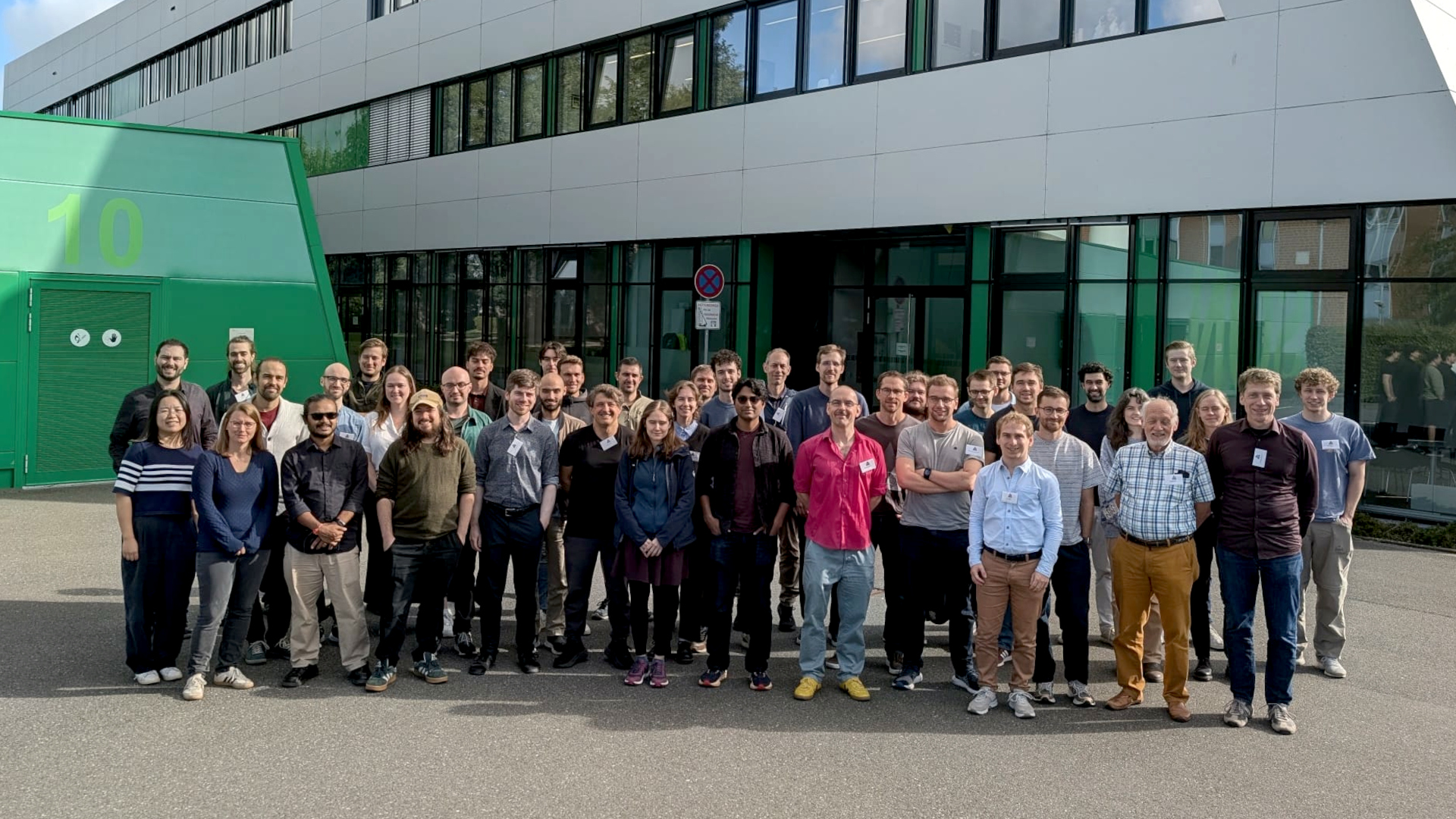
Structure of Quantum Theory

Europe/Berlin
Center for Soft Nanoscience (SoN)

Center for Soft Nanoscience (SoN)

Busso-Peus-Str.10 48149 Münster Germany
Hippolyte Dourdent, Matthias Kleinmann (Department for Quantum Technology)
Beschreibung

The workshop Structure of Quantum Theory aims to bring together experts on the foundations of quantum theory, for example, working on Bell inequalities, contextuality, quantum causality, or generalized probabilistic theories. The workshop aims to create an informal atmosphere with sufficient time for discussions, in order to facilitate collaborations and interactions.

Dates: Monday, September 21st 2026 – Thursday, September 24th 2026. Talks will be from Monday morning to Thursday noon.

Speakers:


Call for contributions:

Submissions for contributed talks or posters are welcome. Please register by sending an email to hippolyte.dourdent@uni-muenster.de by Friday, 17 July 2026.


Travel information:
Münster is well connected by train. The closest airports are (travel times):

  • 1 hour: Dortmund DTM, Düsseldorf DUS
  • 2 hours: Köln/Bonn CGN, Hanover HAJ
  • 3 hours: Frankfurt FRA, Amsterdam AMS, Hamburg HAM

In Münster, the most efficient transport is by bike or public transport.


Organized by the Foundations of Quantum Theory group at the University of Münster.

    • 09:00 09:45
      Armin Tavakoli 45m
      Sprecher: Armin Tavakoli
    • 09:45 10:30
      Bell nonlocality without input choices in quantum networks 45m

      After many decades of studying quantum nonlocality in bipartite and "trivial" multipartite scenarios, the field is now showing interest in networks where multiple independent sources distribute physical systems to different sets of parties. The study of nonlocality in networks is resulting very fruitful, with many interesting results, especially at the foundational level. Yet, the need to take into account the independence of the sources makes understanding network correlations difficult in general. In this talk, I will exemplify this difficulty by trying to answer the question "what is the simplest demonstration of quantum nonlocality in networks?". This will take us through a journey that begins at the very start of the field in 2012 and ends by demonstrating that quantum nonlocality in the triangle network without inputs and with binary outcomes is possible. This demonstration refutes an 8-year-old conjecture in the field.

      Sprecher: Alejandro Pozas-Kerstjens
    • 10:30 11:00
      Coffee Break 30m
    • 11:00 11:30
      Robust certification of high-dimensional quantum devices 30m

      Certifying quantum behavior from classically accessible data is essential for secure communication and scalable quantum technologies. While powerful certification methods such as Bell nonlocality and quantum steering exist, their implementation typically requires entanglement or additional assumptions, and experimental demonstrations mainly focus on low-dimensional systems. In minimal prepare-and-measure scenarios [1], where a sender encodes information into quantum states and a receiver performs a single measurement, robust certification becomes particularly challenging, especially in the presence of noise and in higher-dimensional Hilbert spaces. In this talk, we will present a recent theory-experiment work [2] where we propose, design, and experimentally implement a protocol that certifies quantumness between two distant parties without the need for preshared resources or measurement incompatibility. The experiment is carried out using the orbital angular momentum degrees of freedom of single photons, chosen for increased dimensionality that is scalable. We demonstrate the robustness of the protocol through rank‑stability analysis of the observed correlations, which enables the certification of non‑classicality even in the presence of noise. These results provide a practical route to validate high-dimensional quantum communication systems and open new possibilities for secure and dimension-efficient quantum information processing. More broadly, this talk will also cover the basics and existing challenges of certification via communication, and the recent advances in the field.

      [1] Background, theory and current limitations in certification via communication: https://arxiv.org/abs/2308.07727, https://arxiv.org/abs/2303.06990.
      [2] Main work to be presented (high-dimensional protocol + experiment): https://arxiv.org/abs/2605.04338

      Sprecher: Albert Rico
    • 11:30 12:15
      Nicolas Gisin 45m
      Sprecher: Nicolas Gisin
    • 12:15 14:30
      Lunch 2h 15m
    • 14:30 15:15
      Mirjam Weilenmann 45m
      Sprecher: Mirjam Weilenmann
    • 15:15 15:45
      Coffee Break 30m
    • 15:45 16:15
      A Missing Causal Principle: Coordination 30m

      We propose a novel causal principle that is a genuinely multipartite extension of Reichenbach’s common cause principle, namely, the coordination principle: parties in a network can achieve perfect randomized coordination—in particular, agree on a uniformly random output—only if they all share a common cause. We show that this principle does not follow from the standard no-signaling and independence principles by providing an explicit theory satisfying all these principles while violating the coordination principle. Strikingly, we prove that the coordination principle holds, however, in quantum theory for four parties, and derive noise-tolerant Bell-like inequalities that certify a common cause. We then extend these results to a genuinely quantum coordination task, showing that the four-partite GHZ state requires a quantum common cause which can also be certified by experimentally accessible Bell-like inequalities. A companion paper Ref. [1] generalises these results for N parties, proving that the coordination principle is satisfied in general for quantum theory.

      This talk will be based on two upcoming publications:
      https://arxiv.org/pdf/2605.03120
      https://arxiv.org/pdf/2605.03132 (Ref. [1] above)

      Sprecher: Antoine Coquet
    • 16:15 17:00
      Ravi Kunjwal 45m
      Sprecher: Ravi Kunjwal
    • 17:00 18:30
      Special 1 h 30m
    • 09:00 09:45
      Adán Cabello 45m
      Sprecher: Adán Cabello
    • 09:45 10:30
      John DeBrota 45m
      Sprecher: John DeBrota
    • 10:30 11:00
      Coffee Break 30m
    • 11:00 11:30
      Quantum theory almost fails to be locally tomographic 30m

      Local tomography is the axiom that the state of a bipartite system is uniquely determined by the statistics of product measurements. It is widely employed as a postulate in axiomatic reconstructions of quantum theory. For local tomography to be a physically meaningful property of quantum theory, it should be satisfied robustly: distinguishing quantum theory from any theory violating local tomography should not require infinite precision. We show that this robustness requirement fails by constructing a generalized probabilistic theory (GPT) that violates local tomography, yet no experiment with finite precision, however high, can distinguish it from quantum theory. In this sense, quantum theory almost fails to be locally tomographic. This lack of robustness calls into question the use of local tomography in reconstructions of quantum theory.

      This talk is based on further developments of ideas presented in https://arxiv.org/abs/2601.18872.

      Sprecher: Ladina Hausmann
    • 11:30 12:15
      Chris Fuchs 45m
      Sprecher: Chris Fuchs
    • 12:15 14:30
      Lunch 2h 15m
    • 14:30 15:15
      Marco Túlio Quintino 45m
      Sprecher: Marco Túlio Quintino
    • 15:15 15:45
      Coffee Break 30m
    • 15:45 16:15
      Certification of the genuine resolution of photon number resolving detectors 30m

      Recent progress in photonic quantum experiments has led to widespread use of photon-number-resolving detectors, often described as measurements with many possible outcomes. But what does it mean, operationally, for such a detector to genuinely resolve the number of photons? A device may produce many output labels while being a much coarser measurement followed by classical post-processing. In this sense, the raw number of reported outcomes is not by itself a reliable notion of measurement resolution.
      I will discuss a definition of genuine resolution for quantum measurements, based on outcome simulability. A measurement is said to have resolution at most k if its statistics can be simulated by measurements with at most k outcomes, together with arbitrary classical post-processing and shared randomness. Measurements that are not simulable in this way are therefore genuinely higher-resolution. This provides an operational definition of resolution that is independent of a particular detector model.
      I will then show how this definition leads to a simple certification protocol. In a prepare-and-measure state discrimination game, one can upper-bound the guessing probability achievable by all measurements of resolution at most k. Observing a larger value certifies that the measurement has genuine resolution larger than k. Finally, I will describe an implementation using coherent-state probes of a superconducting nanowire photon-number-resolving detector, where the method certifies genuine four-outcome resolution. The result gives a way to turn informal claims of photon-number resolution into an experimentally testable operational statement.
      Paper link: https://arxiv.org/abs/2606.14365

      Sprecher: Jef Pauwels
    • 16:15 17:00
      Causality and realizability of local operations in quantum field theory 45m

      In quantum field theory (QFT) there are currently two proposals to model local operations. One of them relies on an explicit characterization of all "causal" QFT instruments that do not allow superluminal communication. The other one is the Fewster-Verch framework, which implicitly defines a set of QFT instruments by analogy with non-relativistic measurement theory. FV instruments were quickly shown to be causal, and most people (me included) believed that both sets of instruments were actually the same.
      But we were wrong. Using ideas from quantum nonlocality, in this paper (https://arxiv.org/abs/2607.12976) we find that the causal set is actually larger than the FV set; in fact, it contains quantum channels that would allow two space-like separated parties to violate basic physical principles, like information causality. Exploiting the connection with non-locality a bit more, we show that approximately characterizing the set of FV-realizable instruments is impossible: otherwise, one could solve the problem of approximately computing the quantum value of a non-local game, which we now know it's undecidable. This is an unexpected application of tools from quantum nonlocality in algebraic QFT.

      Sprecher: Miguel Navascués
    • 19:00 21:30
      Conference Dinner 2h 30m
    • 09:00 09:45
      Cyril Branciard 45m
      Sprecher: Cyril Branciard
    • 09:45 10:30
      Jessica Bavaresco 45m
      Sprecher: Jessica Bavaresco
    • 10:30 11:00
      Coffee Break 30m
    • 11:00 11:30
      Bell's go theorem: regaining local causality with a new notion of realism 30m

      Authors: Lorenzo Catani,1 Nesta Van Der Schaaf,2 and Rui Soares Barbosa,3

      1 INESC TEC, Rua da Universidade, 4710-057 Braga, Portugal

      2 Université Paris-Saclay, CNRS, CentraleSupélec, ENS Paris-Saclay,
      Inria, Laboratoire Méthodes Formelles, 91190, Gif-sur-Yvette, France

      3 International Iberian Nanotechnology Laboratory,
      Av. Mestre José Veiga s/n, 4715-330 Braga, Portugal

      Abstract: Bell's theorem is popularly stated as the inconsistency of quantum theory with local realism. More precisely, realism here is mathematically described by the ontological models framework, where the elements of reality are represented by points in a measurable space, and probabilities obey the Kolmogorov axioms. In the Bell scenario, such models amount to a common cause supporting a global valuation— a joint assignment of outcomes to all measurements at once, across mutually incompatible contexts. Within this notion of realism, Bell's theorem implies that any realist explanation of the quantum predictions must be conspiratorial: any underlying mechanism, whether superluminal, superdeterministic, or retrocausal, must be finely tuned so as never to manifest at the operational level.
      In this work, we redefine realism by developing a new ontological framework that generalizes the standard one and takes the incompatibility of measurement contexts seriously. The elements of reality are no longer points but regions of a point-free topological space (sublocales of a locale). These regions are primitive and inherently relational: they act as records that establish the sameness of a measurement across two incompatible contexts without fixing a joint assignment of outcomes across them. The common cause becomes a network of such records rather than a global valuation. Within this framework, Bell's no-go theorem becomes a go theorem: local causality is no longer at odds with the statistics of quantum theory. This is possible because, with no global valuation to preserve, the underlying probability theory generalizes Kolmogorov's, modularity being no longer required across incompatible contexts. We exhibit an explicit family of models in the new framework, reproducing several quantum strategies, including the optimal CHSH violation. More broadly, locally causal models of this kind attain every Bell--CHSH value up to the algebraic maximum.

      Sprecher: Lorenzo Catani
    • 11:30 12:15
      Renato Renner 45m
      Sprecher: Renato Renner
    • 12:15 14:30
      Lunch 2h 15m
    • 14:30 15:15
      Oscar Dahlsten 45m
      Sprecher: Oscar Dahlsten
    • 15:15 15:45
      Coffee Break 30m
    • 15:45 16:15
      Extending superposition to Generalised Probabilistic Theories singles out the quantum tensor product 30m

      Textbook quantum superposition refers to the feature that certain linear combinations of Hilbert space rays, each representing a valid state, are themselves valid states. Recently, superposition has been at the heart of experimental proposals for demonstrating indefinite causal order within quantum theory as well as non-classicality of gravity. However, unlike Bell nonlocality, an operational description of superposition has not been extensively explored. In addition, whether such an understanding can provide insights into finding information-theoretic principles to reconstruct quantum theory has not been explored. In this work we explore both and answer the latter in the positive while making connections between superposition, entanglement and preparational uncertainty.
      We present an operational notion of superposition that is based on constraints on observed measurement statistics. By remaining theory-independent, our definition extends the notion of superposition to frameworks of theories where states are not necessarily represented by rays in a Hilbert space. Specifically, we formalise superposition within the framework of Generalised Probabilistic Theories (GPTs). Far from being a purely descriptive exercise, an operational notion of superposition offers insights into the structure of quantum theory by analysing its relationship with other non-classical features. We use this notion to formulate superposition principles that capture structural features of the quantum state space related to superposition, and we explore the presence of superposition in specific GPTs, including Boxworld, Spekkens' toy model, and regular polygons. We show that the existence of superposition is not automatically implied from the non-classicality of a theory, and that preparational uncertainty and entanglement can be viewed as special forms of superposition. Finally, we show that the quantum tensor product is the largest composition for quantum systems that satisfies all our superposition principles.

      Sprecher: Kuntal Sengupta
    • 16:15 17:00
      Thomas Galley 45m
      Sprecher: Thomas Galley
    • 17:00 18:30
      Special 1 h 30m
    • 09:00 09:45
      Máté Farkas 45m
      Sprecher: Máté Farkas
    • 09:45 10:30
      Martin Renner 45m
      Sprecher: Martin Renner
    • 10:30 11:00
      Coffee Break 30m
    • 11:00 11:30
      Entanglement in prepare-and-measure scenarios without receiver inputs 30m

      The prepare-and-measure scenario has been studied continuously in quantum information over a decade. It is the ubiquitous setting for understanding quantum-over-classical advantages in communication. In their simplest setting, in which the receiver has no measurement inputs, quantum communication offers no advantage over classical communication. In constrast, quantum advantage is accessible by combining entanglement with real-time classical feed-forward.
      In our work we present a systematic investigation of such quantum advantages in prepare-and-measure scenarios without receiver input, we demonstrate a series of key features. We (i) determine optimal tests of classicality and identify the minimal setting in which quantum advantages come about, (ii) reveal that high-dimensional entanglement plays a key role in quantum advantage, (iii) show that non-projective measurements are indispensable for quantum advantage, which contrasts with most other forms of quantum correlations, and (iv) demonstrate that these scenarios are a natural platform for certifying adaptive one-way LOCC, which is important in quantum networks and error correction.
      In summary, our results provide an improved understanding of the prepare-and-measure scenarios without measurement inputs and unveil many of their distinct basic physics features.
      Link: https://arxiv.org/abs/2603.29625

      Sprecher: Elna Svegborn
    • 11:30 12:00
      Advantages of quantum circuits with dynamical causal order for quantum channel discrimination 30m

      The recently introduced frameworks of quantum circuits with classical or quantum control (QC-CCs or QC-QCs) of causal order provide models of higher-order generalised quantum circuits in which a classical or quantum control system determines the order in which different agents apply their operations. Classical control endows QC-CCs with a well-defined causal order, whereas quantum control endows QC-QCs with a so-called indefinite causal order. Importantly, in both frameworks the control state need not be fixed in advance but may instead be established during the computation, giving rise to so-called dynamical causal order.
      While the information-processing advantages of processes with indefinite causal order have been extensively investigated in various information processing tasks of quantum metrology, quantum communication, or quantum channel discrimination, the computational power of dynamical causal order—either classically or coherently controlled—has remained largely unexplored.
      In this work, we investigate the information-processing advantages of quantum circuits with dynamical causal order over their non-dynamical counterparts through a new multipartite quantum channel discrimination task. In the tripartite setting, we establish a separation showing that both QC-CCs and QC-QCs with dynamical causal order outperform the corresponding quantum circuits with non-dynamical causal order. We then extend our analysis to the fourpartite setting, where we prove a separation at the corresponding quantum channel discrimination task between three distinct notions of dynamicality: non-dynamical causal order, dynamical but non-influenceable causal order, and dynamical and influenceable causal order. Our results therefore allow us to better understand the extent to which dynamical causal order—whether classically or coherently controlled—can be a computational resource.

      Sprecher: Raphaël Mothe
    • 12:00 12:15
      Conclusion 15m